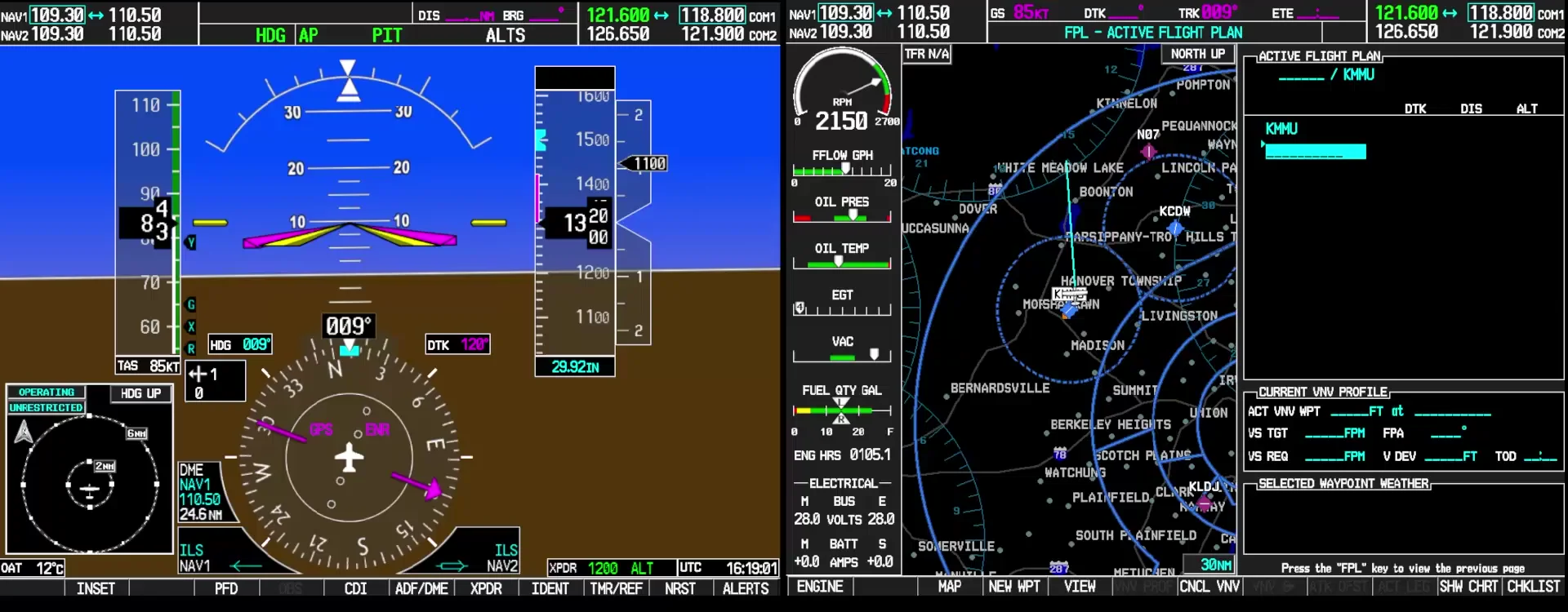
Your first IFR flights aren't about proving you can fly instruments—they're about anchoring your simulator habits in the airplane. You'll start exactly as you did in the sim: with attitude, heading, altitude, and power. The difference is physical feedback—sound, vibration, and real ATC. That's where you'll feel the workload spike for the first few hours.
GOAL:Rebuild your scan, keep the airplane trimmed, and prove your sim discipline holds under motion and noise.
RESULT:You'll recognize that what felt theoretical now becomes muscle memory.
By this point, your scan feels automatic and your brain is freed up for higher-order tasks: intercepting, sequencing, briefing, and managing energy. You'll fly multiple approaches per flight—holds, vectors, missed approaches—and begin stringing them together under light IMC conditions with your CFII.
GOAL:Move from controlled repetition to dynamic decision-making.
RESULT:The radio becomes background music. You're ahead of the airplane again.
Instead of flying circles near the field, you'll start logging real miles and real experience. Each lesson builds both IFR skill and cross-country time—typically 50 NM legs out and back with full procedures at each end. You'll start flying actual routes, managing workload, and integrating ATC communication in context. This phase connects your procedural skills to situational awareness—how navigation, weather, and traffic interact in the real system.
GOAL:Use each flight to log cross-country time and IFR experience simultaneously.
RESULT:You'll start thinking and briefing like an instrument pilot—not just an approach technician.
You're ready for real cross-country IFR missions—250 NM routes with three different types of approaches. At this point you'll already have:
• Your 20 hours of AATD simulator time logged.
• Most of your 15 CFII airplane hours completed.
• A realistic checkride timeline—often within one month of starting aircraft work.
GOAL:Complete checkride requirements efficiently while polishing your judgment and endurance.
RESULT:Transition complete. You're not just instrument proficient—you're operationally ready.