
Make More of Every Cirrus Flight Lesson
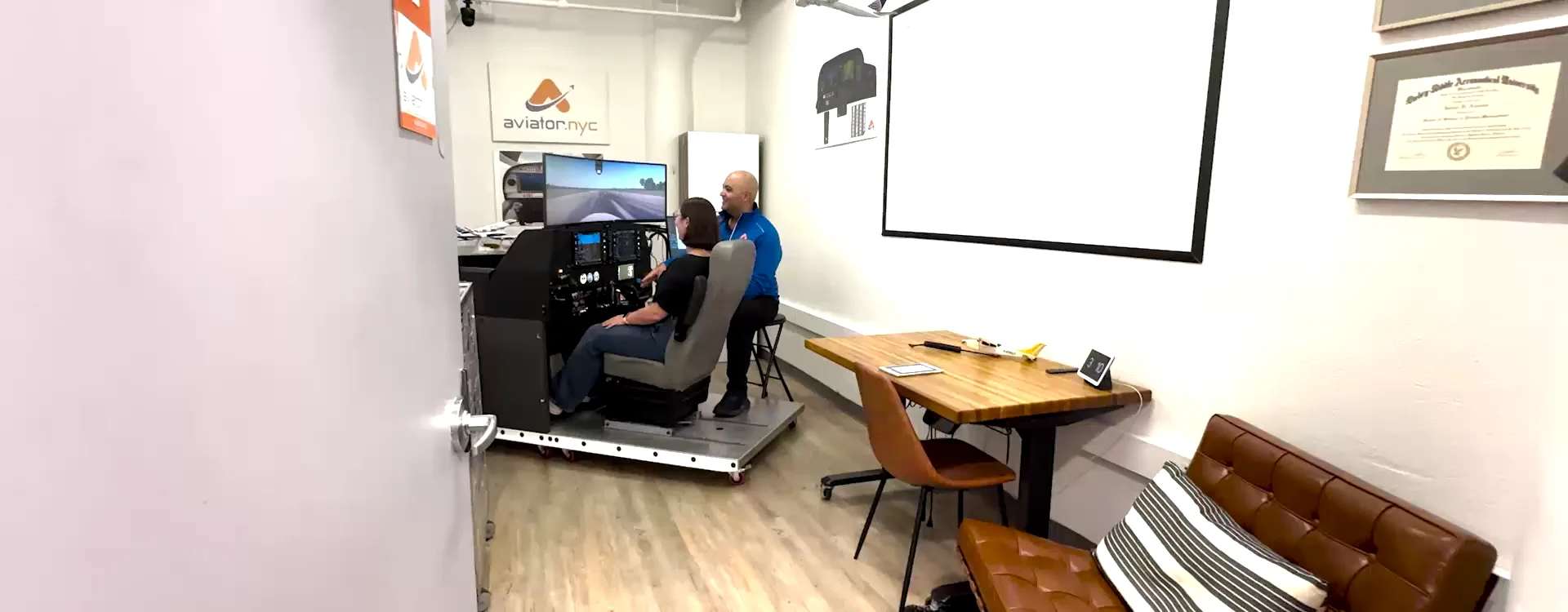
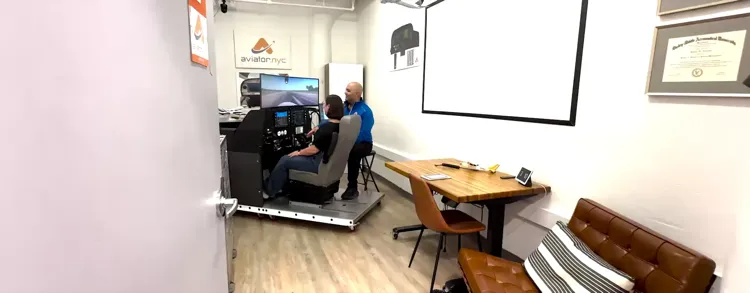
Learning to fly in a Cirrus is a serious investment. Use simulator time before each lesson to learn the basic workflows, avionics, and procedures with experienced instructors, so your time in the airplane is spent flying—not trying to absorb everything for the first time.
What Does Private Pilot Training Look Like?
6 structured lessons. FAA-certified G1000 NXi simulator. Airline pilot instructors.
- Simulator setup and controls overview
- Local airports: Republic (KFRG), Morristown (KMMU), Westchester (KHPN)
- Flight training roadmap: medical, checkrides, written exams
- Ramp Start — Engine and avionics startup from cold and dark
- Systems Demo — Power, radios, engine management, flaps
- Taxi Practice — Rudder pedals, brakes, holding short of runway
- Takeoff & Climb — Smooth power, heading with rudder, climb to 4,000 ft
- Flight Controls — Gentle turns, level flight, trim basics
- Descent & Approach — Glide descent to a visual target point
- Review what you experienced
- Log your simulator time (AATD, dual)
- Discuss training goals and next steps
- Review the four fundamentals of flight (straight-and-level, climbs, descents, turns)
- Watch Sporty's "Four Fundamentals" videos
- Explore ForeFlight or FltPlan Go on your iPad
- Interpreting METARs and TAFs (aviation weather reports)
- Checklist review: what each section covers and how it's used
- Airport familiarization: taxiway diagram, wind, runway selection
- Cold Start — Complete Before Start and Taxi checklists
- Weather-Informed Briefing — Review ATIS/METAR, select runway
- Taxi with Wind — Control deflection and correct turns
- Takeoff at Vy — Normal takeoff with wind correction, climb to 4,000 ft
- Maneuver Practice — Straight and level, shallow turns, coordinated climbs
- Glide Exercise — Power-off descent to an aiming point
- Review maneuvers and checklist technique
- Preview performance takeoffs in Lesson 3
- Practice reading METARs daily at aviationweather.gov
- Chair-fly the checklists while looking at the C172 G1000 poster
- Spend 10 minutes listening to ATC via LiveATC.net
- How aircraft systems affect safety and pilot workload
- Reading basic performance charts (takeoff roll vs temperature)
- Using ForeFlight for runway, weather, and obstacle info
- Student Pilot Certificate: when and how to apply via IACRA
- Systems Brief — Engine, magnetos, avionics, fuel, battery walk-through
- Checklist Review — Before-start, run-up, and takeoff flow
- Performance Takeoffs — Heavy and short-field conditions
- Climb & Turn — Vy, pitch control, visual situational awareness
- Return to Airport — Fly a pattern with simulated radio callouts
- How performance affects takeoff and climb strategy
- Begin your IACRA application for Student Pilot Certificate
- Complete IACRA registration and get your FAA Tracking Number (FTN)
- Review Sporty's videos on glass cockpit and flight instruments
- Read Airplane Flying Handbook Chapter 6: Flight Instruments
- Pitot-static and gyroscopic instrument systems overview
- Six-pack vs G1000: traditional and glass cockpit comparison
- Common failure modes and what to look for
- FAA Medical Certificate classes and how to apply
- Instrument Familiarization — Each primary instrument and its function
- Partial Panel Demo — Control with simulated instrument loss
- Instrument Maneuvers — Climbs, turns, descents using attitude indicator and VSI
- Return to VFR — Transition from instruments back to visual cues
- ForeFlight Demo — Overlay approach charts and load METARs
- Instrument usage and limitations review
- Steps to schedule your FAA Medical Certificate exam
- Schedule appointment with an Aviation Medical Examiner (AME)
- Review traffic pattern legs: upwind, crosswind, downwind, base, final
- Read PHAK Chapter 14: Airport Operations
- Standard traffic pattern: all five legs
- Airport communications: CTAF, ATIS, Ground, Tower
- Part 61 vs Part 141 school types and flexibility
- Full checklist flow: start through landing
- Start & Taxi — Real weather, full run-up and ATC callout
- Pattern Work — Full circuits: takeoff, downwind, landing approach
- Radio Phraseology — CTAF/Tower communications and position reports
- Airport Familiarity — Load KFRG, KCDW, or KHPN diagrams
- Evaluate Airports — Compare Class D vs Class C traffic mix
- Runway selection, crosswind management, pattern accuracy
- Questions to ask when visiting a flight school
- Visit 1–2 flight schools in person (use evaluation questions from lesson)
- Review Sporty's Airspace Series (Class B, C, D, E)
- Study the NYC sectional chart
- Reading sectional charts: shelves, altitudes, boundaries
- NYC airspace: Class B (JFK/EWR), Class C (LGA), Class D (FRG, MMU)
- Filing and flying near controlled airspace as a student pilot
- Comparing aircraft: Cessna 172, Piper Warrior, Cirrus SR20, Diamond DA40
- Chart Orientation — NYC airspace using ForeFlight or sectional chart
- Airspace Entry — Transitions through Class D into Class C/E
- Pattern Work — Circuits with simulated radio calls
- Aircraft Familiarity — Avionics and layout differences between types
- Situational Awareness — Cross-check traffic and weather, adjust course
- Pattern consistency and airspace entry performance
- Which aircraft matches your goals and flying style
- Book an introductory flight in 1–2 different aircraft types
- Review everything you've learned — you're ready for real-world training
What Do You Learn in 6 Simulator Lessons?
| Skill Area | L1 | L2 | L3 | L4 | L5 | L6 |
|---|---|---|---|---|---|---|
| Starting the engine | — | — | — | |||
| Taxiing on the ground | — | — | — | |||
| Takeoff and climbing | — | — | — | |||
| Flying straight and turning | — | — | — | |||
| Descending and approaching | — | |||||
| Using checklists | — | — | ||||
| Using ForeFlight | ||||||
| Reading weather reports | — | — | — | — | — | |
| Crosswind takeoffs | — | — | — | |||
| Airplane performance planning | — | — | — | — | — | |
| Flying a full pattern circuit | — | — | — | |||
| Radio calls to ATC | — | — | — | |||
| Reading flight instruments | — | — | — | |||
| Instrument climbs, turns, descents | — | — | — | — | ||
| Airport operations | — | — | — | — | ||
| Choosing a flight school | — | — | — | — | — | |
| Navigating NYC airspace | — | — | — | — | — | |
| Comparing training aircraft | — | — | — | — | — | |
| Handling emergencies | — | — | — | — | — |
How Long Is a Flight Lesson? 2-Hour vs 3-Hour Sessions
| 2-Hour Session | 3-Hour Session | |
|---|---|---|
| Briefing | 15–30 min | 20–30 min |
| Simulator Time | 75–90 min | 135–150 min |
| Debrief | 5–10 min | 10–15 min |
| Hands-On Flying | ~75 min | ~135 min |
| Best For | Weekly pacing | Deep practice, fewer visits |
| Price (dual) | $380 | $570 |
| Bundle | $780 / 6hr (3× 2hr) | Use 6hr bundle for 2× 3hr |
Every student learns differently. While these lessons follow a proven structure, your instructor adjusts pacing, depth, and focus areas based on your learning style, experience level, and goals.
Full lesson plans available at Private Pilot Lesson Plans
How Much Does a Private Pilot License Cost in 2026?
A private pilot license costs between $24,420 and $32,000 depending on your training path. At Aviator.NYC, our Smart Path approach starts with simulator foundations before aircraft time, bringing your total to $24,420–$24,920 — saving $3,000–$5,000 compared to traditional training. The national average is $27,000–$32,000 because students repeat lessons lost to weather delays and scheduling gaps. Our 3-phase program breaks costs into clear stages: simulator foundations ($1,520), solo proficiency with dual instruction ($8,000), and cross-country plus checkride prep ($14,900–$15,400). Every phase includes ongoing simulator refreshers so you don't pay aircraft rates to re-learn basics. Airline pilot instructors at our Hudson Square, Manhattan location keep your training efficient and your costs predictable.
Weeks 1–2 · FoundationsFoundations in the Simulator
Phase Cost$1,520Running Total$1,520
Foundations in the Simulator
- First complete lesson (2 hours): hands-on controls, basic maneuvers, and radios ($380)
- 6-hour simulator training bundle to build core skills before aircraft time ($1,140)
- Core ground knowledge: airspace, weather basics, local airports, and simple flight planning
- Radio communication practice so you can talk to ATC without freezing
- Instrument scan, checklists, and abnormal procedures in a low-pressure environment
By the end of this phase, you walk into the airplane already knowing how to hold altitude, navigate, manage checklists, communicate on the radio, and understand basic aerodynamics.
Weeks 3–12 · Solo ProgressSolo Proficiency & Dual Instruction
Phase Cost$8,000Running Total$9,520
Solo Proficiency & Dual Instruction
- 20 hours dual instruction in aircraft ($300/hr = $6,000)
- 10 hours solo practice ($200/hr = $2,000)
- Midweek simulator refreshers (4 sessions included) so you don't re-learn basics every weekend
- First solo flight, pattern work, and local area maneuvers to build real confidence
You're comfortable flying solo, can handle the traffic pattern confidently, and perform the core maneuvers every private pilot is tested on.
Months 3–12 · Checkride ReadyCross-Country, Night, and Checkride Prep
Phase Cost$14,900 - $15,400Running Total$24,420 - $24,920
Cross-Country, Night, and Checkride Prep
- 30 hours dual instruction ($300/hr = $9,000)
- 20 hours solo cross-country & practice ($200/hr = $4,000)
- 3 hours night flying ($300/hr = $900)
- Targeted checkride prep sessions (simulator + aircraft) focused on your weak spots
- FAA written exam prep and checkride ($1,000-$1,500)
- Ongoing simulator sessions to stay sharp between aircraft flights and avoid losing momentum
You complete your long cross-country, meet your night requirements, pass your FAA checkride, and earn your private pilot certificate—with skills you trust, not just a piece of paper.
Smart Path vs Traditional Training
Smart Path (Simulator + Aircraft)
$24,420 - $24,920
- Simulator training (8 hours) to build your foundation before the aircraft: $1,520
- 50 hours dual instruction focused on higher-value flight time: $15,000
- 30 hours solo practice to lock in skills between lessons: $6,000
- Exam & checkride fees (FAA written + practical): $1,000-$1,500
- Ongoing simulator refreshers to prevent rust and repeated lessons: Included
Save $3,000-$5,000 by building skills in the simulator before aircraft time. Fewer repeated lessons, more focused aircraft time, and a clearer path to your checkride.
Traditional Flight School
$27,000 - $32,000
- 60-70 hours dual instruction with more time spent re-learning basics: $18,000-$21,000
- 30-40 hours solo practice without structured simulator support: $6,000-$8,000
- Exam & checkride fees (similar to Smart Path): $1,000-$1,500
- Repeated lessons due to rust, weather delays, and long gaps: $2,000-$3,000
More aircraft hours are needed to learn the basics, and weather plus schedule gaps often lead to repeated lessons, higher total cost, and a greater chance of stalling out before the checkride.
Cost estimates are based on FAA national averages and typical student progression. Your actual costs may be higher or lower depending on your learning pace, aircraft rental rates, and how often you train. Simulator training significantly reduces overall costs by building proficiency before aircraft time, so you spend fewer hours (and dollars) re-learning the same skills in the airplane.

Your Instructor at Aviator.NYC Is an Airline Pilot
You're not being taught by "flight instructors" — you're being mentored by airline pilots.
Starting out is overwhelming because no one hands you a clean roadmap.
We give you a repeatable way to fly — prioritize, stay organized, build transferable habits.

Arrive Prepared for Every Flight
Our FAA-certified simulator lets you master the fundamentals—instrument scan, radio calls, emergency procedures—so you step into the airplane confident and ready to progress.
Master the fundamentals here. Arrive at the airplane prepared to progress.
Non-U.S. Citizen?
TSA approval is required before your second lesson. We do NOT sponsor visas.
We do NOT sponsor visas.
Learn about TSA requirements →How Our Airline Pilot Instructors Help You Succeed
Most new students worry: "Can I actually do this?" However, our instructors don't just teach you to fly — they also guide you through every challenge that stops 80% of student pilots from finishing.
"I don't understand aviation jargon"
First, we break aviation terms into plain English. Then we add the technical vocabulary. For example, you'll learn "airspeed" means "how fast you're moving through the air" before we introduce "indicated vs. true airspeed."
"I'm nervous about making mistakes"
First, practice failures safely in the simulator. Then build muscle memory before the airplane. For example, you'll rehearse engine-outs, electrical failures, and emergency landings risk-free — so nothing in the aircraft catches you off guard.
"I work M-F and can't get to the airport during the week"
Train Tuesday evenings in Manhattan, then fly Saturday mornings at the airport. In addition, you stay sharp between flights with midweek simulator sessions — so no month-long gaps can destroy momentum or force you to re-learn basics.
"I don't understand aviation jargon"+
First, we break aviation terms into plain English. Then we add the technical vocabulary. For example, you'll learn "airspeed" means "how fast you're moving through the air" before we introduce "indicated vs. true airspeed."
"I'm nervous about making mistakes"+
First, practice failures safely in the simulator. Then build muscle memory before the airplane. For example, you'll rehearse engine-outs, electrical failures, and emergency landings risk-free — so nothing in the aircraft catches you off guard.
"I work M-F and can't get to the airport during the week"+
Train Tuesday evenings in Manhattan, then fly Saturday mornings at the airport. In addition, you stay sharp between flights with midweek simulator sessions — so no month-long gaps can destroy momentum or force you to re-learn basics.
Location
TRAIN TO FLY IN MANHATTAN
Hudson Square, Manhattan

Loading reviews...
Tap any station for live arrival times


Why Hobby Pilots Train
at Aviator.NYC
Professional instruction in Manhattan. Build skills here, fly at the airport.
Airline Pilot Instructors
Learn from professionals who fly professionally.
Manhattan Location
Train in Hudson Square, minutes from any subway line.
FAA-Certified Simulator
Realistic training that counts toward your certificate.
Flexible Scheduling
Book sessions when it works for you. Evenings and weekends available.
NYC Location. FAA-Approved Simulator.
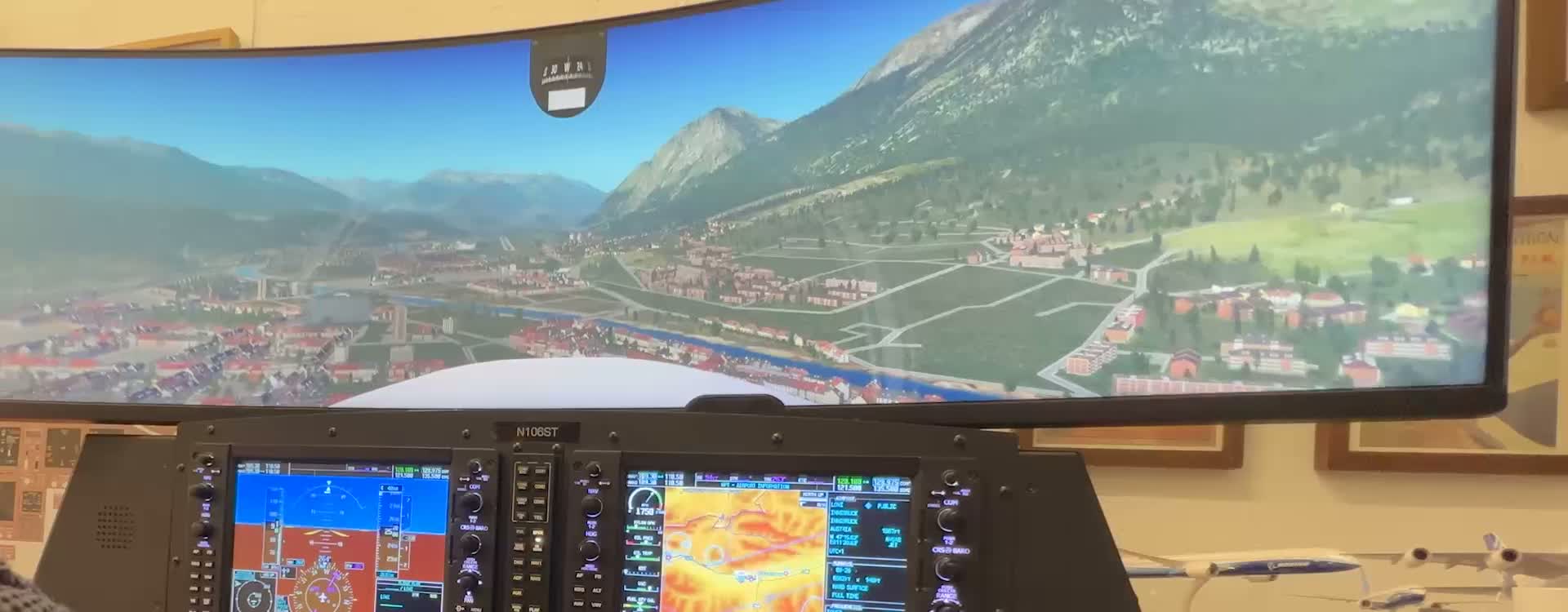
Built by Precision Flight Controls • Model GTX G1000 • FAA AATD Certified
Private Pilot Training
Most pilots earn their private certificate between 80-100 hours, often re-flying lessons due to weather or scheduling gaps. At Aviator.NYC, you can train during the week—rain or shine—on the same G1000 NXi system found in modern trainers. Use the simulator as your weekday flight lab to practice procedures, polish radio work, and stay ahead of your next real flight.
Plan Your Flight In Minutes
Pick a session, see the steps, and reserve instantly.
Trusted by 500+ NYC pilots and students
Have a Question About Flight Training?
Ask us anything about private pilot training, costs, timelines, or our simulator.