See It. Learn It. Practice It. Then Fly It.
Our proven methodology: simulator-first training that builds real IFR competence
See It in the Simulator
We can fly from New Jersey to Nantucket to show you how a specific approach works. Then compare it to another approach at a different airport to highlight the differences. Can't do that in the airplane—weather, time, and cost make it impossible. In the simulator? We can show you 5 different approaches in one session.
- ✓Work with airline pilots who fly these procedures for a living
- ✓No weather delays, no airport drives
- ✓Real nav data—same charts you'll use in flight

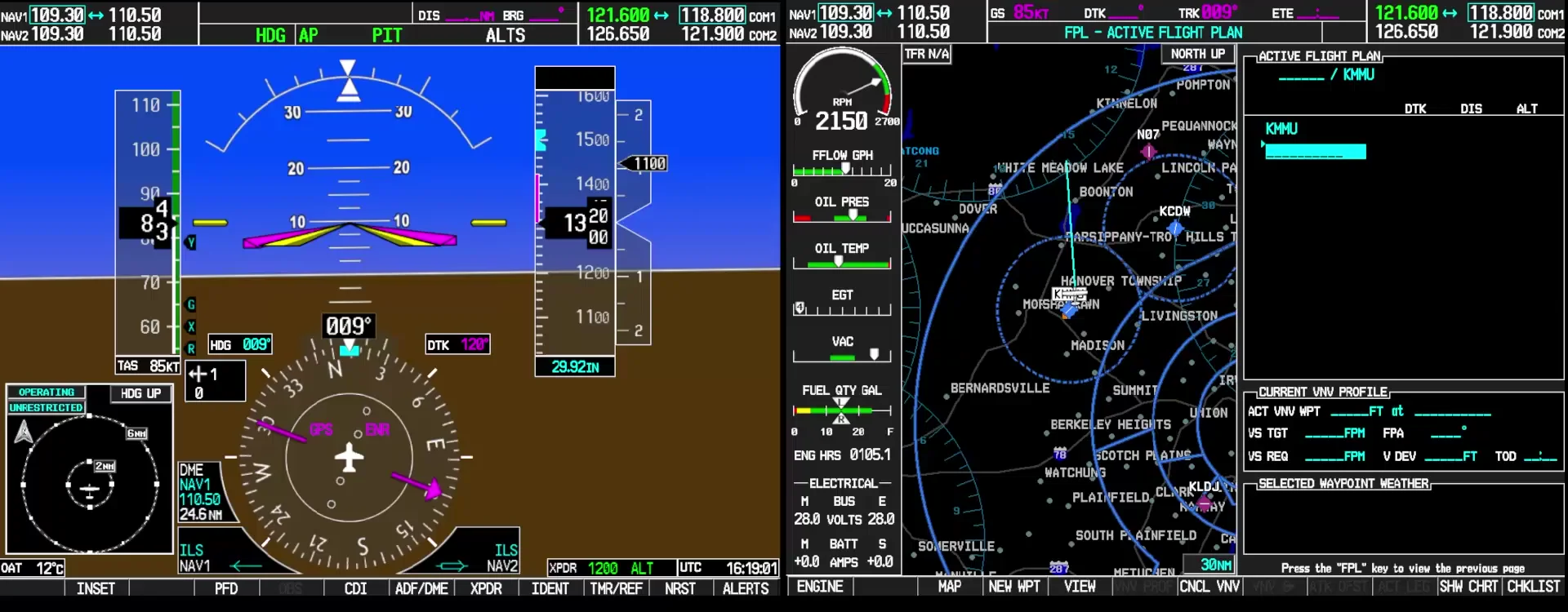
Build Instrument Proficiency on a Cirrus G3000 Simulator
Train for your instrument rating on the Garmin G3000 Perspective Touch+ interface used in current Cirrus SR20, SR22, and Vision Jet aircraft. Build real IFR workflow with active airline-pilot instructors in Manhattan.


Build IFR Skills with Airline-Pilot as Your CFI-I
Instrument training rewards structure — and airline pilots live in structure.
Organize your IFR work so it transfers cleanly to your airplane CFII.
Better briefings. Cleaner setup. Steadier pacing. More consistent execution.
Train with Real
Navigation Data
Our G1000 NXi runs the same worldwide navigation database used in active aircraft. Current AIRAC cycle. Real procedures. The same SIDs, STARs, and approaches you'll fly on your checkride.

IFR Currency Session Pricing
Choose hourly for occasional practice. Choose bundles to save when you need more reps.
With Instructor
Airline pilot CFII guides you through approaches, holds, and procedures
Hourly = pilots who fly IFR regularly and need occasional practice.
Bundle = pilots rebuilding proficiency or prepping for an IPC.
What Happens in Your First IFR Lesson?
Structured instrument training with an airline pilot CFI-I. FAA-certified simulator.
Simulator Session (90 min)
- Partial panel attitude flying (attitude indicator only)
- Progressive instrument introduction: altimeter, then heading
- Full panel transition: Pattern A, Vertical S maneuvers
- Trim management and basic instrument scan
What Does 20 Hours of IFR Simulator Training Look Like?
10 lessons. 20 hours of FAA-loggable AATD simulator time. Garmin G1000 NXi cockpit.
- Start with attitude instrument flying and IFR clearances
- Progress through VOR navigation, holding patterns, and non-precision approaches
- Advance to ILS precision approaches, GPS/RNAV procedures, STARs, and emergency scenarios
- Every lesson: 20-min ground briefing, 90-min simulator flying with your airline-pilot CFI-I, 10-min debrief with pilot preparation
- Lesson 10 simulates a full instrument checkride flight profile
- Your first IFR lesson is a 2-hour session: 20-minute ground briefing, 90 minutes in the G1000 NXi simulator, and a 10-minute debrief.
- You build your instrument scan from scratch — starting with partial panel (attitude indicator only), then progressively adding instruments until you fly full panel.
- Your airline-pilot CFI-I covers IFR clearance structure and flight planning basics.
- IFR flight planning: Republic Airport (KFRG) to Bedford (KBED)
- Weather briefing and ForeFlight chart organization
- IFR clearance structure and readback practice
- G1000 setup: input route, NAV radios, flight director
- Partial panel attitude flying (attitude indicator only)
- Progressive instrument introduction: altimeter, then heading
- Full panel transition: Pattern A, Vertical S maneuvers
- Trim management and basic instrument scan
- Scan technique and G1000 effectiveness review
- Trim and control management in maneuvers
- Plan IFR flight KFRG to KBED in ForeFlight
- Watch: Loading Flight Plan in G1000 NXi
- Read: Instrument Flying Handbook Ch. 6-7 (attitude flying with EFD)
- You learn VOR navigation — radials, bearings, TO/FROM logic — and fly your first holding patterns with direct, parallel, and teardrop entries.
- The simulator work covers autopilot modes (HDG, NAV, FLCH, VS) and dual VOR cross-checks.
- You brief your first approach plate: the VOR 24 into Nantucket (KACK).
- VOR navigation: radials vs bearings, TO/FROM, CDI vs bearing pointers
- IFR flight plan: Morristown Airport (KMMU) to Allentown (KABE)
- Holding pattern components and entry types
- Approach briefing introduction: VOR 24 at Nantucket (KACK)
- Pattern A, Vertical S1, Teardrop maneuvers
- Holding entries: 80/260, teardrop, direct
- Flight Director and autopilot modes: HDG, NAV, FLCH, VS
- Dual VOR navigation with radial intercepts
- Common radial/course errors and TO/FROM logic
- Hold entry timing and G1000 bearing pointer use
- Watch: Instrument Holds in G1000 — Two Methods
- Read: IFH Ch. 5 (autopilot systems), Ch. 7 (EFD maneuvers)
- Brief VOR 24 into Nantucket (KACK) using approach plate
- You fly your first instrument approach to minimums — the VOR 24 at Nantucket (KACK) as a full procedure.
- You execute it three ways: autopilot NAV mode, heading/VS mode, and hand-flown with raw data.
- Holding patterns become part of real approach segments rather than isolated exercises.
- VOR approach plate interpretation and briefing format
- IAF vs vectors: definitions and G1000 loading techniques
- Approach configuration: flaps, power, autopilot setup
- Missed approach flow review
- VOR 24 at Nantucket (KACK): full procedure, no vectors
- Three execution modes: autopilot NAV, HDG/VS, and manual raw data
- Holding pattern entries integrated into approach segments
- VOR 6 at Martha's Vineyard (KMVY) with radar vectors (time permitting)
- Hold entry selection and approach tracking review
- Configuration and missed approach execution
- Practice approach briefings (voice record for confidence)
- Read: IPH — approach segments, takeoff minimums, alternates
- Watch: Flying KUAO LOC 17 (preview for next lesson)
- Non-precision approaches use lateral guidance only — you descend to an MDA without a glideslope.
- You learn step-down fixes, missed approach points, and the MDA vs DH distinction.
- The lesson covers VOR approaches at KACK and KMVY, plus your first LOC approach at KSBP.
- MDA vs DH: non-precision vs precision approach concepts
- Step-down fixes, MAP identification, and descent profiles
- G1000 approach configuration and stabilized approach criteria
- Missed approach brief: full flow from go-around to ATC call
- VOR 24 KACK: autopilot, HDG/VS, and manual modes
- VOR 6 KMVY: radar vectors to final, no procedure turn
- Hold execution with wind correction and timing
- LOC 11 KSBP introduction: localizer tracking to MDA
- Configuration management and descent timing
- Missed approach decision-making review
- Read: IPH 4-37 to 4-42 (glidepaths, missed approach, IAP briefing)
- Watch: Conquer the VOR 24 Approach at KPOU
- Review: "Everything Explained" — non-precision approaches, alternates
- You fly your first ILS precision approach and first GPS approaches — a major expansion in capability.
- The lesson covers three RNAV types (LNAV, LNAV/VNAV, LPV) and SID departures from Teterboro (KTEB).
- You practice full missed approach automation including TO/GA and SUSP mode.
- Precision vs non-precision: ILS components, DH vs MDA
- GPS approach types: LNAV, LNAV/VNAV, LPV minimums
- SID procedures: plate interpretation, threat identification
- Missed approach automation: TO/GA, SUSP, configuration flow
- SID departures from Teterboro (KTEB): every runway to top altitude
- LOC 11 at KSBP: full procedure with briefing and configuration
- ILS 11 at KSBP: glideslope tracking and precision to DH
- Full missed approach execution with automation
- Glideslope tracking technique and ILS vs LOC differences
- GPS vs conventional navigation comparison
- Watch: How to Fly an RNAV Approach (KTIX RNAV 18)
- Watch: Approach Activation — Vector-to-Final, Approach, Leg
- Read: IPH 4-63 to 4-66 (ILS categories, simultaneous approaches)
- You build proficiency by flying full procedure approaches without ATC vectors.
- Starting from Stewart Airport (KSWF), you fly the VOR 24 at KPOU using complete routing through IGN intersection.
- The focus is cross-checking navigation sources — switching between NAV1, NAV2, and bearing pointers.
- Full procedure routing: KSWF departure to IGN to VOR 24 KPOU
- ILS 11 KSBP review: intercept and glideslope management
- Procedural routing vs ATC vectors comparison
- NAV source switching: GPS vs LOC1/LOC2 in G1000
- VOR 24 KPOU: full routing from KSWF via IGN, no vectors
- Manual CDI settings, procedure turn, outbound timing
- ILS 11 KSBP: autopilot and manual LOC + glideslope intercept
- Cross-check navigation sources: NAV1, NAV2, bearing pointers
- Station passage identification and outbound intercept timing
- G1000 annunciation awareness and staying ahead of the airplane
- Watch: Master the G1000 VNAV Feature
- Watch: How to Fly an RNAV Approach — KTIX RNAV 18
- Read: "Everything Explained" — GPS approaches, precision approaches
- STARs are published arrival routes that sequence you from cruise altitude to an approach fix.
- You fly the LVZ STAR into Morristown (KMMU), programming VNAV crossing restrictions in the G1000.
- The lesson covers LPV, LNAV/VNAV, and LNAV-only approaches with simulated ATC changes enroute.
- STAR chart interpretation: RNAV vs non-RNAV arrivals
- VNAV programming: crossing altitudes, target fixes, profile view
- Loading STAR and approach transition in G1000
- ATC-style changes: altitude, speed, and routing amendments
- LVZ STAR to KMMU: meet MUGZY crossing restriction via VNAV
- Monitor altitude, speed, and lateral deviation throughout
- Fly LPV, LNAV/VNAV, and LNAV-only RNAV approaches
- Handle simulated ATC speed and descent changes enroute
- Vertical navigation planning and constraint compliance
- Reprogramming G1000 fixes and altitudes in-flight
- Watch: Climb Gradient for IFR Flight — Parts 1-3
- Read: IPH 4-25 to 4-34 (WAAS, LPV, LNAV, Baro-VNAV)
- Review: "Everything Explained" — precision approaches, GPS, IFR departures
- You practice FAR 91.185 lost communication procedures — AVEF route logic, 7600 squawk, and the decision tree for navigating without ATC.
- During a KMMU-to-KSYR cross-country, your instructor simulates mid-flight reroutes and comm failure.
- You also practice holds with EFC timing and crosswind correction.
- Lost comm procedures: FAR 91.185, AVEF route, MEA altitude
- Squawk 7600, visual ID, tower coordination for re-entry
- Diversions in G1000: Direct-To, OBS mode, flight plan editing
- EFC logic and "hold for release" instructions
- IFR flight KMMU to KSYR with mid-flight ATC reroute
- Simulate reroute: Direct SAX to V252 to GDM
- Hold at SAX with EFC time and 15 kt crosswind
- Lost comm scenario: follow FAR 91.185 decision tree
- Decision-making under lost comm scenarios
- Direct-To vs full reroute via edited flight plans
- Read: IPH 3-3 to 3-9 (descent planning and CFIT prevention)
- Watch: OBS Mode in G1000 and IAF vs Vectors videos
- Review: "Everything Explained" — diversions, fuel reserves, alternate logic
- You handle progressive system failures in IMC — PFD failure, ADC failure, and GPS loss.
- Using G1000 reversionary mode and backup instruments, you fly approaches without primary displays.
- This is the most demanding session, building confidence in the aviate-navigate-communicate decision framework.
- G1000 reversionary mode and MFD takeover
- Electrical failure hierarchy: essential bus, load shedding, alternator
- GPS failure vs RNAV database expiry implications
- Backup instruments: standby attitude, magnetic compass
- PFD failure: fly using MFD reversionary mode
- ADC failure: navigate with compass and backup attitude indicator
- Non-GPS approach scenario (LOC or VOR without moving map)
- Progressive system failures with approach execution
- Emergency priorities: aviate, navigate, communicate
- Failure recognition speed and partial panel proficiency
- Read: IFH Ch. 10 — IFR Flight (departure to arrival to alternate minimums)
- Watch: 6 Common Mistakes in Instrument Approach Briefings
- Final review: "Everything Explained" — top 10 checkride errors
- Lesson 10 simulates the full instrument checkride: SID departure, enroute navigation, holding, multiple approach types to minimums, missed approach, and diversion to an alternate.
- Your instructor plays DPE, asking common oral exam questions between segments.
- You leave with a clear readiness assessment.
- Checkride format: oral exam areas and flight test ACS standards
- Common DPE questions and decision-making scenarios
- Crosswind operation techniques and personal minimums
- Weather-below-minimums scenario planning
- Complete IFR cross-country: file, depart (SID), enroute, hold
- Multiple approach types to minimums (VOR, LOC, ILS, RNAV)
- Missed approach execution and diversion to alternate
- System failure scenarios and backup procedure demonstration
- Checkride readiness assessment and weak area identification
- Oral exam preparation strategy and recommended study
- Review: FAA Instrument Rating ACS standards
- Practice: oral exam question bank
- Book your DPE checkride appointment
What IFR Skills Do You Build in 10 Lessons?
| Skill Area | L1 | L2 | L3 | L4 | L5 | L6 | L7 | L8 | L9 | L10 |
|---|---|---|---|---|---|---|---|---|---|---|
| Instrument Scan & Attitude Flying | N | P | R | R | R | R | R | R | R | R |
| Trim & Configuration Mgmt | N | R | R | P | R | R | R | R | ||
| IFR Flight Planning & Briefing | N | P | P | R | R | R | R | P | R | |
| G1000 NXi Programming | N | P | R | R | P | R | P | P | R | |
| ATC Communication | N | R | R | R | R | R | R | P | R | R |
| Partial Panel Flying | N | P | R | |||||||
| Autopilot & Flight Director | N | R | R | P | R | P | R | |||
| VOR Navigation | N | P | P | R | R | R | ||||
| Holding Patterns | N | P | P | P | R | |||||
| VOR Approaches | N | P | R | P | R | |||||
| Missed Approach Procedures | N | P | P | R | R | |||||
| LOC Approaches | N | R | P | R | ||||||
| ILS Precision Approaches | N | R | P | R | ||||||
| GPS/RNAV Approaches | N | P | R | |||||||
| SIDs & Departures | N | R | R | |||||||
| STARs & VNAV Descents | N | R | R | |||||||
| Diversions & Lost Comms | N | R | R | |||||||
| Emergency Procedures | N | R |
How Long Is an IFR Simulator Session?
| 2-Hour Session | 3-Hour Session | |
|---|---|---|
| Briefing | 15-20 min | 20-30 min |
| Simulator Time | 85-95 min | 140-150 min |
| Debrief | 5-10 min | 10-15 min |
| Hands-On Flying | ~90 min | ~145 min |
| Best For | Weekly pacing, one approach type per lesson | Deep practice, multiple approach types |
| Price (dual) | $380 | $570 |
| Bundle | $780 / 6hr (3x 2hr) | No dedicated bundle |
| Recommended | Standard IFR progression | Advanced students, checkride prep |
Every instrument student has different experience and learning pace. We tailor the lesson order and emphasis to your background — a VFR pilot learning from scratch gets a different approach than a rusty instrument pilot refreshing skills. Your instructor adjusts in real time.
How It Works
Start in the Simulator
Book your first 2-hour lesson with an airline pilot instructor.
- No airplane rental costs
- No weather cancellations
- Pause, rewind, and repeat any procedure
Log 20 FAA-Approved Hours
Complete our structured 10-lesson curriculum.
- Approaches, holds, emergencies, and a mock checkride
- Every hour counts toward your instrument rating
- Save $4,400+ vs. airplane-only training
Transition to the Airplane Ready
Hit the aircraft with real IFR skills already built.
- Progress faster in the airplane
- Spend less on aircraft rental hours
- Pass your checkride with confidence


PRACTICE SOLO. NO CHECKOUT.
Practice IFR procedures on your own time. Drill approaches, holds, and flows between lessons so you get more from every hour with your instructor.
- +Same G1000 NXi you train on
- +Reinforce what you learned in dual
- +Book any available time slot
FAA Instrument Rating Requirements
Here's what the FAA requires for your instrument rating. Up to 20 hours can be logged in an FAA-approved AATD simulator like ours.
Accelerate Your In-Airplane IFR Training
Whether you train with us or elsewhere, these strategies will help you get the most value from your in-airplane IFR instruction. Click any tip for detailed guidance, or watch our airline pilots share proven techniques.
In-Airplane IFR Training Tips
Location
TRAIN TO FLY IN MANHATTAN
Hudson Square, Manhattan

Loading reviews...
Tap any station for live arrival times
Why IFR Students
Train Here
We're not a traditional flight school. We're a simulator training center built for serious IFR students.
Airline Pilot Instructors
Learn from professionals who fly professionally.
Manhattan Location
Train in Hudson Square, minutes from any subway line.
FAA-Certified Simulator
Realistic training that counts toward your certificate.
Flexible Scheduling
Book sessions when it works for you. Evenings and weekends available.
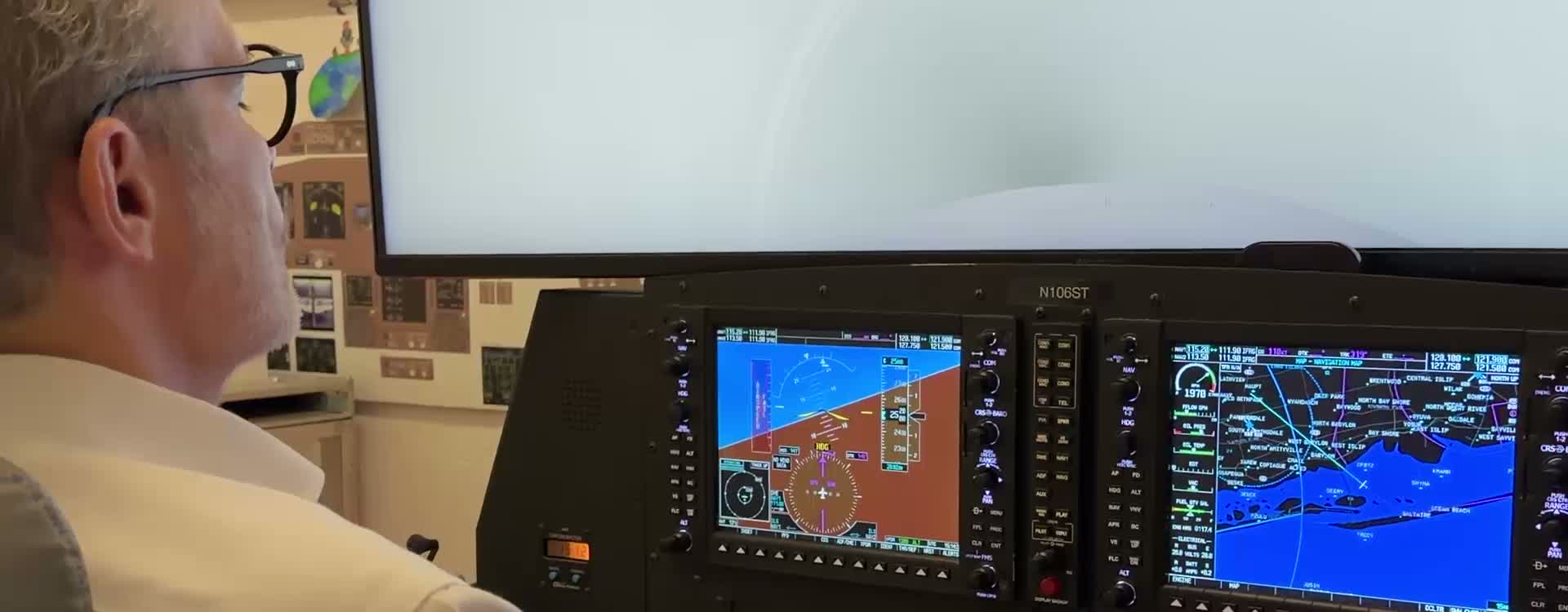
FAA-Certified IFR Simulator
Log up to 20 hours toward your instrument rating in our G1000 NXi AATD.
Instrument Rating & IFR Currency
IFR procedures are complex—from holding patterns to RNAV approaches with VNAV guidance. Our FAA-certified G1000 NXi simulator reproduces every mode and alert you'll encounter in real aircraft, so you learn correct habits from day one. Practice approaches that are too expensive or impossible in an airplane—NDB procedures, international airports, mountain terrain—with airline pilots who fly IFR every day.
Book Your IFR Training
Start your instrument rating journey today.
Trusted by instrument students across NYC
Non-U.S. Citizen?
TSA approval is required before your second lesson. We do NOT sponsor visas.
We do NOT sponsor visas.
Learn about TSA requirements →Instrument Rating FAQs
How to start, simulator hours, approach practice, and checkride prep.
Instrument Rating Essentials
How to start, simulator hours, approach practice, and checkride prep.
Aviator NYC's instrument rating program begins in the simulator — build scan discipline, approach procedures, and radio skills before spending $200+/hour in the aircraft.
- PPL required before starting instrument training (or train concurrently)
- 40 hours of actual or simulated instrument time required (FAR 61.65)
- Up to 20 hours in Aviator NYC's AATD count toward the requirement
- Structured curriculum: basic instruments → holds → approaches → cross-country → checkride prep
Aviator NYC's FAA-approved AATD logs up to 20 hours toward the 40-hour instrument time requirement under FAR 61.65.
- 20 hours AATD: the maximum FAA allows for instrument rating
- All approach, hold, and tracking time is loggable with an instructor
- Practice approaches at Republic Airport (KFRG), Morristown Airport (KMMU), and other local airports
- Smart use of simulator time can save $3,000–$8,000 in aircraft rental costs
Aviator NYC's checkride prep covers every approach type in the ACS: precision (ILS), non-precision (VOR, RNAV), and partial panel.
- ILS: the gold standard precision approach — required for checkride proficiency
- RNAV (GPS): the most common approach in modern GA flying
- VOR: increasingly rare but still on the practical test standards
- Partial panel: demonstrate instrument flying with failed instruments
Aviator NYC offers full instrument rating training on the G3000 Perspective Touch+ — ideal for pilots who fly or plan to fly Cirrus aircraft.
- Same 20-hour AATD maximum applies — G1000 and G3000 hours both count
- G3000 touchscreen approach loading and autopilot coupling for Cirrus workflows
- Train on the avionics you'll actually fly in the aircraft
- G1000 also available for general IFR discipline on Cessna/Piper platforms
Aviator NYC's airline pilot instructors teach approach briefing the way it's done in airline operations — systematic, complete, and fast.
- Identify approach type, minimums, missed approach procedure, and frequencies
- Brief before descending — never while configuring the aircraft
- Aviator NYC uses the MARTHA briefing format: Minimums, Approach type, Radios, Timing, Heading, Altitude
Aviator NYC's instructors see the same approach errors repeatedly — most stem from incomplete briefings and late configuration.
- Descending below MDA/DA without the runway environment in sight
- Failing to identify the final approach fix or missed approach point
- Not briefing the missed approach procedure before starting the approach
IFR Training Resources & Guides
Build instrument proficiency with these guides — from clearances to checkride techniques
Instrument Rating Training Experience
Personal story of earning an instrument rating in NYC — what to expect on your journey.
Instrument Rating Training Tips
Proven strategies to train efficiently — simulator vs aircraft, lesson planning, and checkride prep.
IFR Clearance Proficiency
Master IFR clearances beyond CRAFT — foundational communication skills for IFR flying.
Jeppesen Approach Plate Briefing
Step-by-step Jeppesen chart briefing format used by airline pilots — core technique to master.
Holding Pattern Entry Procedures
Master holding pattern entries with interactive calculators — essential checkride skill.
IFR Departure Climb Gradients
Calculate and fly required climb gradients on departure procedures — obstacle clearance techniques.
FAA/NACO Approach Chart Briefing Guide
FAA approach plate briefing technique — what to brief, when to brief it.
Flying Instrument Approaches
Practical technique for flying precision and non-precision approaches.
G1000 VNAV Navigation
Master vertical navigation on the G1000 — setup, descent planning, and common pitfalls.
G1000 Approach Activation Tips
Navigate approach activation on the G1000 — vectors-to-final, HILPT, and transition selection.
RNAV Equipment Requirements
Understand RNAV equipment requirements — what you need to file /G and fly RNAV approaches.
What Is the FAA WINGS Program?
WINGS is the FAA's voluntary Pilot Proficiency Program. Complete activities at your level to earn credits toward a WINGS phase — which can replace your flight review. Our simulator sessions are FAA-accepted WINGS activities at three proficiency levels.
master Level
ATP/CFI ACS
3 credits per session
Airport operations + flight operations + knowledge
Each session earns 3 of 4 credits needed. One Risk Management credit completes the phase.
advanced Level
Commercial ACS
2 credits per session
Flight operations + knowledge
Each session earns 2 of 4 credits needed. Two sessions plus knowledge activities complete the phase.
basic Level
Private Pilot / Instrument ACS
2 credits per session
Flight operations + knowledge
Each session earns 2 of 6 credits needed. Three sessions plus knowledge activities complete the phase.
Which Scenarios Can You Fly?
Every session is different. Pick any scenario below — each one earns FAA WINGS credit and challenges a different instrument skill. No required order.
Structured IFR currency session to regain or maintain instrument currency under 14 CFR §61.57(c). Six approaches, holding, and intercepting/tracking.
Mountain IFR flying through Colorado with convective weather and terrain challenges.
Desert-to-urban IFR with high density altitude, terrain, and busy Class B airspace.
Mountain crossing IFR through the Cascades with icing and low visibility.
Get-home-itis scenario with deteriorating weather and decision-making pressure.
Coastal IFR with marine layer, fog, and fatigue/business pressure decision-making.
Short-hop IFR through NYC Class B with complex arrival procedures and unfamiliar aircraft.
Corporate flight into major Class B airport with sequencing, speed restrictions, and personal urgency.
Medical delivery mission under time pressure with low IFR conditions.
Transport-category profile with full SID/STAR sequencing. Airline interview prep and single-pilot jet IFR training.
Northeast corridor IFR with Class B departures, busy ATC, and complex arrival procedures.
Mountain IFR into challenging terrain with special approach procedures and weather considerations.
Mountain resort destination with terrain challenges, special procedures, and weather decision-making.
Hawaiian inter-island IFR with oceanic procedures, volcanic terrain, and tropical weather.
South American high-altitude IFR with challenging terrain, international procedures, and mountain weather.
Hub-to-hub STAR flow with "descend via" clearance, NorCal flow control, and marine layer ILS.
Mid-Atlantic coastal IFR through military airspace with Chesapeake Bay moisture and low-IFR arrival.
Business jet northeast corridor with Class B departure, reroute amendments, and BOS STAR compression.
Caribbean overwater IFR with tropical convection, limited diversion options, and island terrain approach.
High-altitude hub with terrain-ringed basin, rigid STAR step-downs, and 7,316-foot elevation approach.
Complex Heathrow SID with multiple constraints, European procedures, and Alpine terrain approach.
Short-haul Alpine IFR with FOEHN winds, terrain-constrained MEAs, and compressed task timeline.
View all 22 WINGS scenarios and earn FAA proficiency credits →
Questions About Instrument Training?
Get personalized guidance on your path to an instrument rating.